Transfer functions are a (often non-linear) mapping of the luminance of each pixel of an image to the displayed luminance, or back.
Its purposes are to :
- Optimize the size of numeric files
- Historically, to compensate for the non-linearity between CRT tube voltage and light intensity.
There are 2 types :
- OETF = Opto-electronic tranfser function
- Light —> Recorded signal
- Camera
- EOTF = Electro-optical transfer function
- Recorded signal —> Light
- Screen
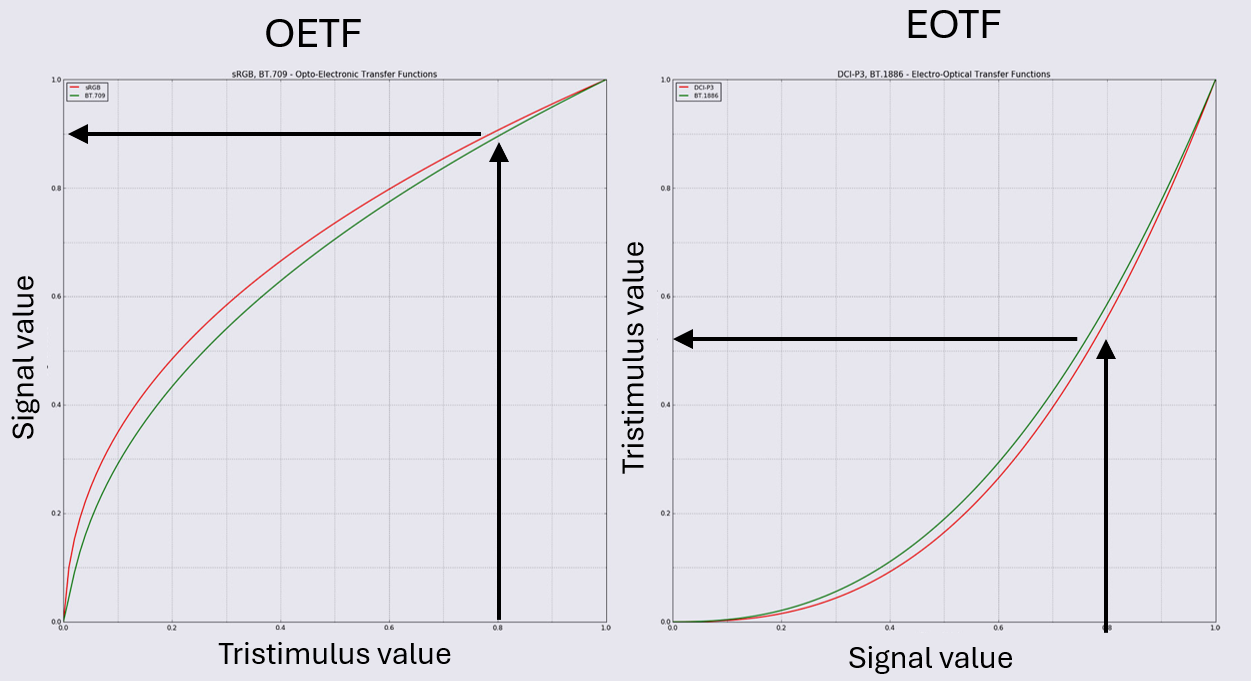
Gamma compression
Transfer functions are generally exponential-ish.
This is because by chance, 2 effects cancel out :
- CRT monitors’ luminance is not proportional to the electric voltage applied to the CRT tube,
- The human eye is more sensitive to subtle differences between dark colors than subtle differences between light colors. Therefore, recording information density according to human perception saves info density in areas of a photo that cannot be seen by the human eye.
By recording a modified signal, information density is preserved, and the signal is ready to be displayed by a CRT monitor.
Since the transfer function is exponential(-ish), and the letter gamma ( ) is used to note an exponent, the intensity of this function is called gamma.
In sRGB, the transfer function follows a gamma of 2.2.
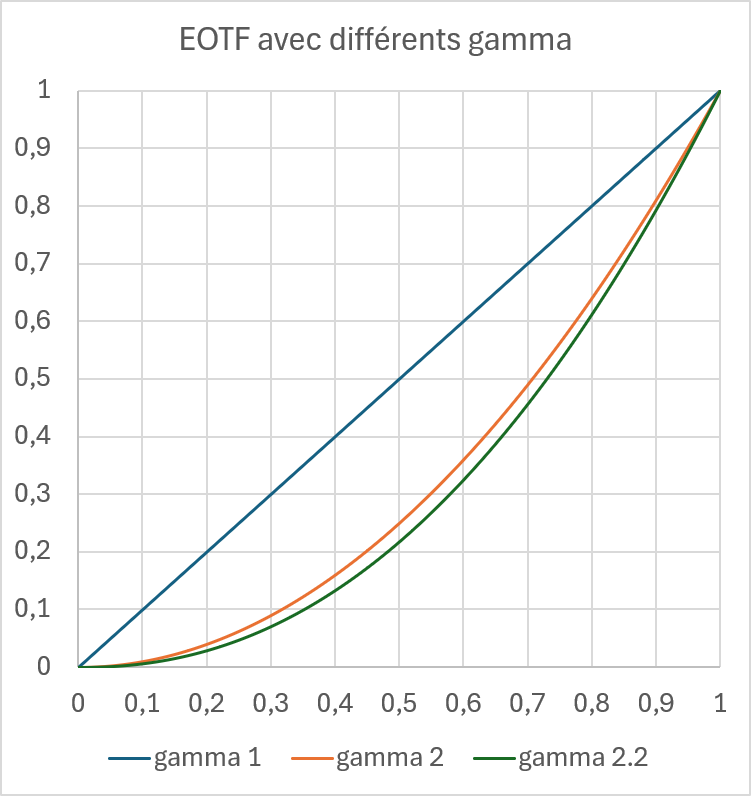
Gamma correction
Unlike the gamma used to encode signals, the “gamma correction” is a deliberate and artistic modification of the image, which is akin to contrast correction
Questions
Are there more mapping rules ?
What is gamma when it comes to film photography ?
Gamma is a number (ex : 2.2). What does this represent ? Simething to do with exponentials ?
Sources
- Gamma correction - Wikipedia
- Chapter 1: Color Management - Chris Brejon
“Transfer functions” section